LATENCY – Or Why You’re Always Late
If you’re a musician – then hello victim! If you’re a guitar player and /or vocalist performer we need to talk…
Guitarists – your digital footpedals – those wonderful do-all simulators of the analog sounds of musical heroes and their gear – those pedals of tomorrow’s sounds here today and maybe yesterday – all have nasty little problems and one of them is built right in. Vocalists – don’t feel left out – you’re in the game, too. Because our D pedal dreams of nostalgic magic powers and future artistic fates – the one pedal that would finally get your act signed or make you reproductively eligible – is more about the promise of technology than the delivery thereof.
And therein lies the rub.
Have we discussed, “The Case of the Digital Curse of Latency”, lately? It begins when you destroy your original analog audio signal by digitizing it. You lose more than just your timbre and tone. For your musical soul must be decimated and converted to the binary church of numbers and then excommunicated and banished back to the real world. In this transformational data grind the Troll of Time extracts its toll in milliseconds and none shall throughput until delayed.
Recall that analog musical electronics are essentially instantaneous. Digital electronics are also super-fast in the digital domain. But every conversion – A to D and D to A – is an opportunity to delay your signal and degrade your sound art. And it’s later than you might think.
Digital latency is not good for performing music or recording music or for the performer. Time smear, loss of groove, loss of feel, loss of group sync, wooden playing, performer timing errors, “you’re dragging” – “no it’s you”, unexplainable vocal pitch problems, extreme irritation and so on. It’s all about signal arrival times, the degree of phase distortion, distorted harmonic series, narrow Q frequency emphasis, the dreaded comb filter and more – if you order now. And wait for it – you can even get mild to wild simulator sickness from delayed perceptual feedback cues. Let’s not even speak about vestibular /visual conflicted expectations. At least not now. The US Navy and NASA among others documented these physical side effects years ago. It’s online.
Anyway here are some mfgr.’s published claimed average throughput times (ms).
I have included other equipment that a vocalist /guitarist would use in a live club or small hall performance. Because besides footpedals – wireless mics, digital mixers (or analog with digital effects) and in the ear monitor systems, also need to come to terms with musicality, interfacing and the Arrow of Time. And remember, as some digital processors loads are increased, throughput times as well as errors may (will) also increase, no matter what they claim.

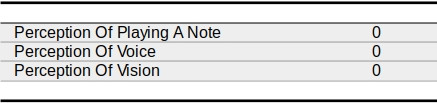
And some of your personal perceptual delays (excluding expanded or contracted states of consciousness)
The top window is a spectral plot of a source audio signal.
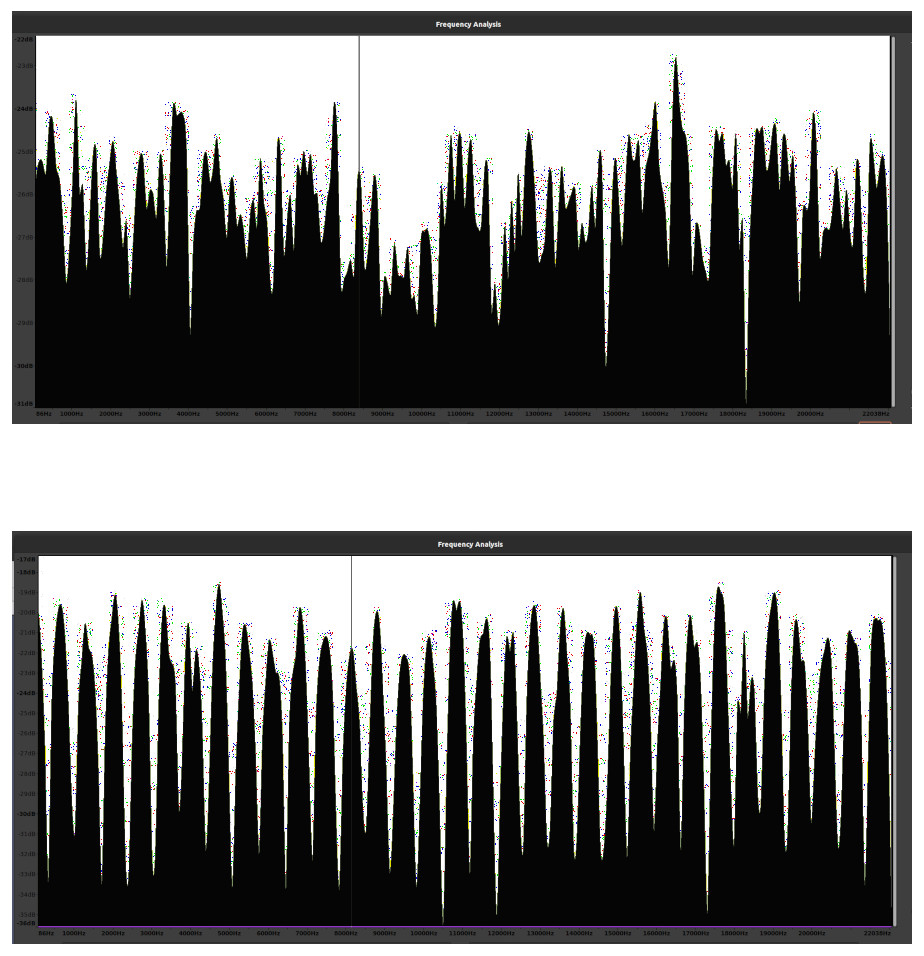
The bottom window is a spectral plot of the sum of 2 signals, the source and a duplicate, delayed by 14.5ms.
Good luck on those tasty nuances.
And the best part – you, your ears and brain are now functioning as a discreet audio summing device and synchronizer of arrival time offsets – both audio and visual. In the ear monitors make it worse.
“What about floor monitors, fills and all?”, you say, “they have delays!”. Ah yes, but they are acoustical delays from fixed exterior speaker placements and correlate well visually and audibly with your own location at anytime. It is an open system. Even with considerable signal latency it is still possible to build a mental image of position. In the ear systems are closed systems – they isolate. Their is no correlation of visual and audio images because the electronic delay of audio signal that you perceive is not dependent on your physical location – ever.
You have become a human audio filter and an ill-equipped Timelord. The lunatic really is in your head. And its got a comb.
Musical equipment companies don’t want to dialog about the “L” word. “3ms – surely that’s too small to matter” – they cry. Well maybe but for instance, Jamie Oldaker, drummer for Eric Clapton among others, said that when he auditioned for “Stayin” Alive”, the timing variance window that the producer required was “+/- 2ms”. Scientists in Germany recently EEG wired acoustic Jazz musicians and proved that group synchronous occurs while playing together. unamplified. All their brains were in sync-lock. You need a conductor for an orchestra because of the delays that naturally occur when players are widely separated. Signal timing is very important to music – OK?
(Click diagram to enlarge)
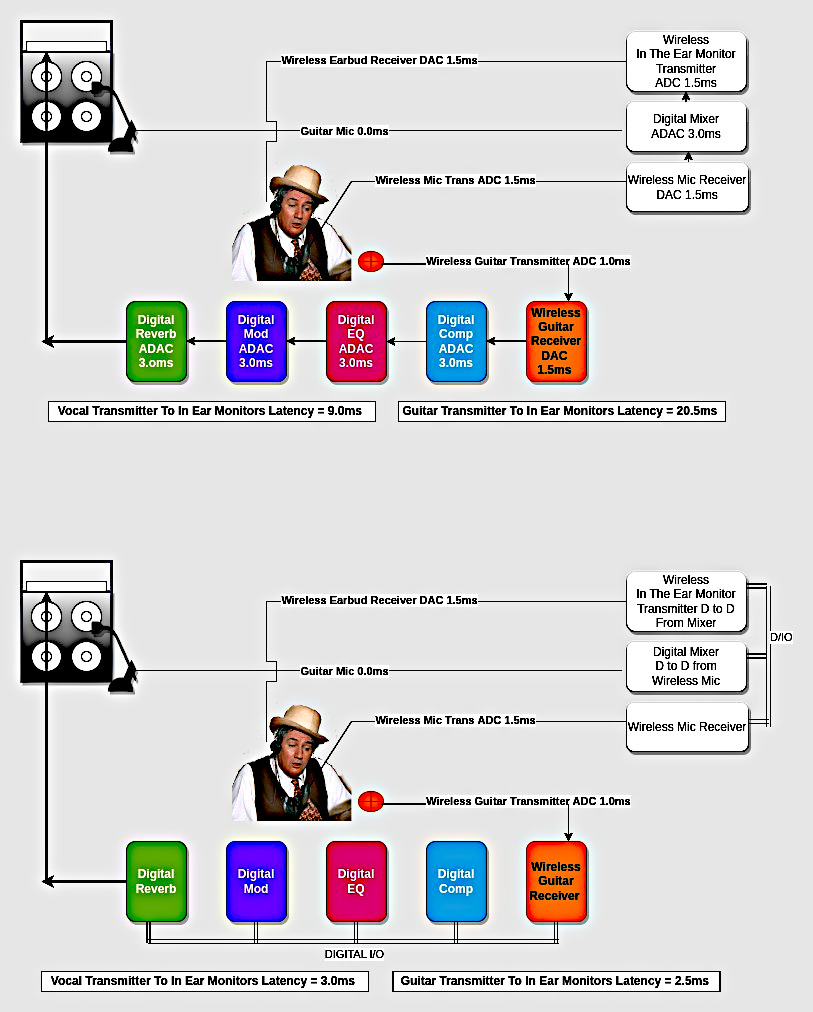
Would you like multiple ADA Conversions or just one total ADA Conversion?. One? Sorry that choice is not available.
Der Eine Kleine Middle Klasse Musik Gerat
There are no footpedals with a SDIF, Tos-Link Optical or AES D I/O available on the US market to my knowledge and if it’s USB equipped (and by the way what a horrible connector to put on a pedal) – the manufacturer can’t be bothered to make it able to interface in the digital domain with other companies’ pedals and often not even their own! Well shameful. What year is it? Really…? At the time of writing this column none of the mfgs. have addressed it. Please tell us we missed a meeting. They seem to think you use one pedal only or one at a time – lol. How about a Musical Equipment Digital Standard? They don’t need no stifling new standards bro’. Then how about an existing one? They must love the special sound of multiple ADA conversions.
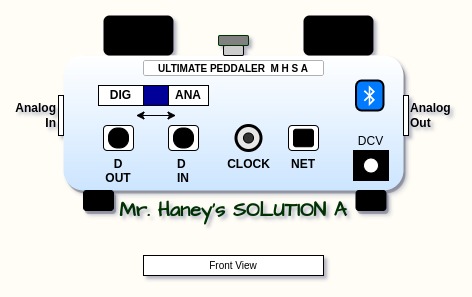
Companies such as Line 6 have partially addressed the latency problem by having wireless guitar receivers on their multi-effects units. The Effects Loop on your Amplifiers can also help by not marrying your dry signal with your effects before input. But…
Criticality has been reached – it’s paradigm shift time.
The Manufacturers need to stop jiving the crap out of us with their Marketing Over Music approach. Luckily the Virtual Wizards of Impulse Response and Emulation are not all audio illusionists designing myth machines for the masses and their money. There are a few really smart artists making some very interesting and original, creative digital pedals, some are even worth having – damn it.
We believe they just need to prodify (production modify) their designs into more useful musical tools in order to help musicians create new recognizable and repeatable sonic effects – fx icons of special individual character. And no – pitch correction glitches are not what we mean. Finally, the whole Music Audio Industry needs to concentrate on systematic ways to reduce or optimize latency. Perhaps a new approach.
For the sake of sound art and musical sanity.
Meanwhile – reject useless toys. Buy used. Go all analog, as if you can, until maybe one day, sooner or later, they’ll get around to dealing with it.
Zed Cross
special thanx to Geoff Bond for his contribution to this article.
© 2023 by Sound Art Magazine.com
 SOUND ART M A G A Z I N E